
The raw brutality of war

Starting on 26 September 1936 the Carlists of the 3rd Company of the Regiment of Lácar climb from Elgoibar via the hermitage of San Pedro and occupy Mount Kalamua and Arrate after heavy fighting, and will go on to conquer Akondia. Also involved in this action was the Carlist “requeté” (militia) Regiment of Lesaca with around 400 men, and the conquest of the sanctuary of Arrate, the community located there and the hamlet Cantabria, situated next to the sanctuary, stand out. The 2nd Company of Lácar occupies Mount Morkaiko on the 26th, but with ten dead and forty-five wounded in their ranks.
The 1st Company of Lácar takes the Urkarregi. This action takes place between the 26th and 29th, during which they drive back the loyal troops from Arrate via Krabelin to Mount Aitzketa and to the skirt of Akondia thanks, above all, to the grenades of the Minenwerfer 1916 mortar and the 1916 mine thrower, trench sweepers, which had a range of 300 metres, equipment acquired from the German government as surplus from the First World War. The abundant remains of material found on the road from Aitzketa to Akondia testify to this. In these positions the front of Eibar will stabilise until the end of April 1937.

Officers from Franco’s troops in Elgoibar’s Plaza de los Fueros square. © Ministry of Education and Science. Author: Andrés Erich.
The accompanying figure shows the layout of the fortifications built by the insurgents on the summit of Akondia, which were reinforced with trenches, sniper positions, barbed wire, sandbags etc. The equipment was brought up at night from Elgoibar to avoid attacks. For the first sections this was done with the help of ox carts, and the final sections were completed on foot with the material carried on the shoulders of the soldiers.
In November 1936 the four companies of “requetés” of the Regiment of Navarre present in the Akondia area totalled 450 men. In January 1937 the 1st Company had 115 men in the Urkarregi, the 2nd had 165 in Angiozar, the 3rd had 129 in the spa of Zestoa and the 4th had 55 in the “Tomás Meabe” refuge in Kalamua. In late February the Regiment of San Fermín, the 5th of Navarre, has four companies in the area of Elgoibar. One of its captains, Matías Zaragozan, died near the summit of Akondia on 21 April, and in his memory a stone cross was erected which stood until the spring of 2014 when it was smashed to pieces and so destroyed.
31 March 1937 begins with the bombing of Durango, with a total of 336 dead, the final offensive led by the head of the Northern Army, General Emilio Mola, to raze Euskadi to the ground. Elgeta falls on 24 April and Eibar follows two days later. Bilbao will fall into the hands of the insurgents on 19 June 1937.

Franco’s troops in Elgeta square after the town was captured.
The Navarre brigades present on this front were aided by the “Black Arrows”, a mixed brigade of Italian Fascists under General Piazzoni, which on 2 April are gathered in Elgoibar-Urkarregi-Ondarroa relieving the II Brigade of Navarre. They also had the support of a motorised division, “23rd March”, also Italian. In Bergara, 60 armoured cars from the Italian “Corps” were positioned. When he launched the offensive, Mola had about 33,000 men, 130 guns and an air force of around 150 aircraft commanded by the Nazis and based in Vitoria, Lasarte, Burgos, Logroño and Soria. The deep fuselages of the Italian Savoia 81 and the German Junker 52 had interiors that could accommodate large bombs.
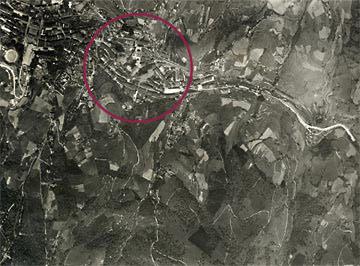
Image taken from an Italian “Savoia-Marchetti, SM-81” plane during the bombing of Eibar showing evidence of three bomb strikes in the zone of Errebal (see below).

For the pursuit of the enemy, they will also be aided by the mixed brigade of the Italian “Black Arrows”, positioned in the Elgoibar-Ondarroa sector and occupying the Urkarregi, the mountain marking the boundary between Bizkaia and Gipuzkoa. After the fall of Eibar the IV Brigade of Navarre leaves Ermua and Eibar and advances towards Bolibar on 26 April, arriving the following day at Etxebarria, Markina and Urberuaga, while the Italians occupy Berriatua in parallel. With the fall of Markina, the columns which for seven months had been besieging the area of Eibar, Elgeta and Markina now join together. The road towards Bilbao begins to open up.

Fighters from the San Andrés and Saseta Battalions, fitting “boosters” to the grenades in their “Valero” 81 mm mortar, in the Markina Sector.

Main image:
Plan of the rebels' fortifications at the top of Akondia. © Archivo General Militar de Ávila. Ministerio de Defensa.
© Eibarko Udala 2026